
Lowry’s Art
It is less us who are looking at the painting than the painting that is looking at us

Dear Readers,
If you believe in the value of quality writing and the importance of creating a space for curiosity, critical thought, and meaningful dialogue, your subscription makes that possible.
Join as a paid subscriber to help build a community that values ideas, reflection, and the exploration of what it means to be human.
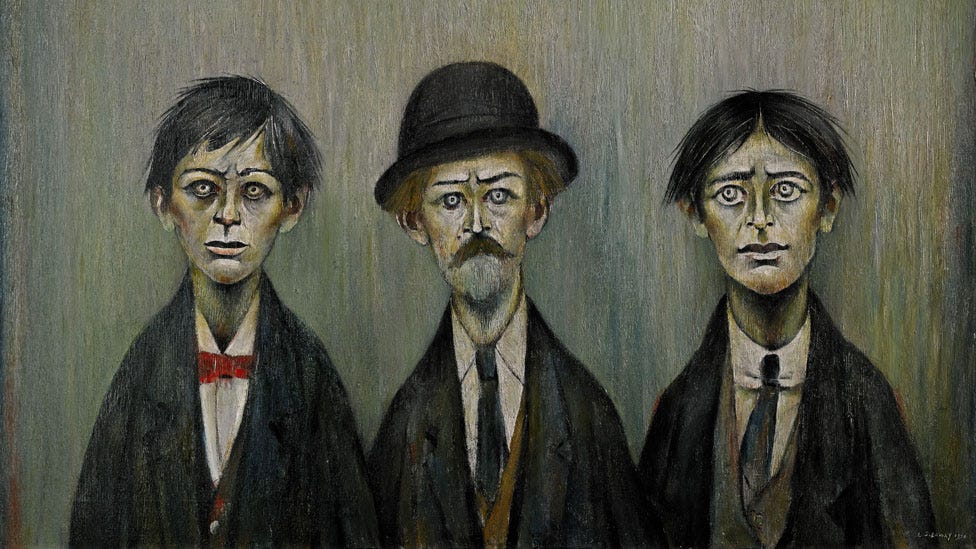
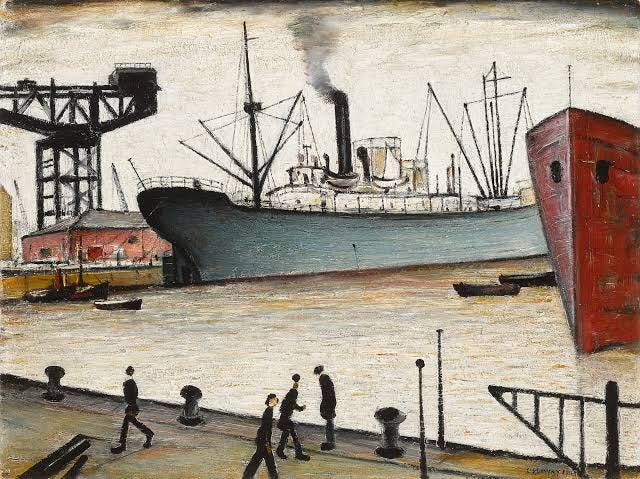
A new exhibition of works by Britain’s much-loved artist Laurence Lowry opening later this year at the Milton Keynes Gallery aims apparently to challenge his image as an ‘industrial painter’ and show another side to him. Lowry was not an isolated documenter of factory life, but a highly cultured person, collecting art, attending the opera and the theatre, and fully engaged in cultural life.
That may well be the case, but there is certainly another side to Lowry that tends to be swiftly forgotten whenever we are reminded of it. A bachelor all his life, Lowry seems to have avoided both romance and sex, yet he entertained a succession of teenage girls, whom he would turn into trusted companions. When thirteen-year-old Carol Ann Lowry wrote to him in 1957, he paid his unrelated namesake a visit and a long friendship developed between then. He encouraged and supported her interests and studies, and always behaved correctly with her, never crossing or blurring boundaries. He was ‘uncle’ to her, and she was ‘niece’.
After the painter’s death, as the main beneficiary of his estate, she received a call from the executors inviting her to the Nat West bank in Manchester to examine some things that had been found in his home. The Lowry works that greeted her could not have been easy to look at: drawings and paintings of a slim young girl, dressed in a variety of costumes, being decapitated with an axe, pushed under a guillotine, strangled, and cut open with a knife.
As she looked through this macabre series of images, Carol Ann could feel herself going cold and the hairs on her neck start to bristle. Recognising the distinctly retrousse nose of the young girl as her own, she realised “My God, it’s me. They are me”.
Although she would later come to consider the girl in the pictures as an imaginary figure for Lowry, the initial moment of horror indexes something that touched her powerfully. If the painter had always behaved impeccably with her, the horrific images showed that the vision of the world broadcast by his more anodyne ‘public’ art hid another way of looking at things, another side to the artist. These private images were intensely violent and sexual, but in a sense it was less the content of the scenes depicted that was so disturbing as the fact that they suggested that this was how Lowry might have been looking at her. Beyond the way she thought he was looking at her was another kind of looking.
