

Dear Readers,
If you believe in the value of quality writing and the importance of creating a space for curiosity, critical thought, and meaningful dialogue, your subscription makes that possible.
Join as a paid subscriber to help build a community that values ideas, reflection, and the exploration of what it means to be human.
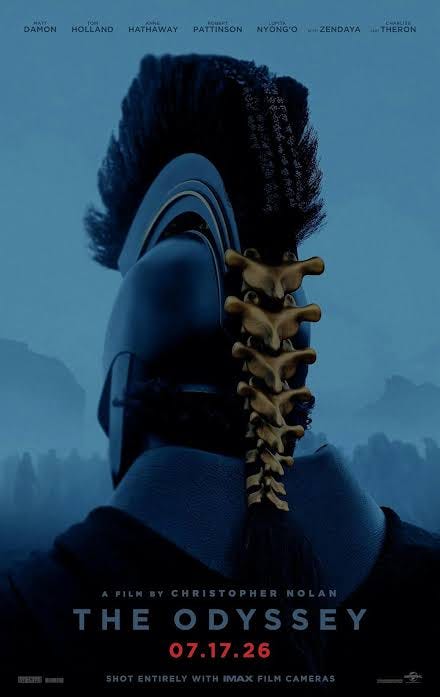
All the hype about The Odyssey seems to have shut down any critical thinking about this ridiculous bloated spectacle, which seems to have imprisoned an otherwise talented cast and crew in a massive cinematic Trojan Horse, entering cinemas everywhere without audiences realising how they are being duped and manipulated.
Sorry if you loved it - the sound design is fabulous, no denying that - but as for the rest it is like a mega-budget version of ‘The Equaliser’ with a very simple message: violence is the best remedy to resolve problematic situations. Odysseus loses all the ambiguity, guile and slipperiness that characterised him in the Homeric poem, and that made him so fascinating to readers over the last few centuries. He now becomes a sort of Jason Bourne figure, killing lots of opponents against all odds, and, in a really poor script decision, a sufferer from PTSD, like a Vietnam veteran, with traumatic flashbacks of the sacking of Troy.
There’s of course no reason not to refigure the Odyssey, to update it and give it relatable content for today’s audiences, but the whole PR spin for the film has stressed its fidelity to the original, despite the fact that the PTSD angle just totally rewrites the Homeric character. Similarly, the director has been busy preaching the film’s message: Zeus’ law that we must treat strangers kindly, as they may be gods in disguise.
This message, repeated ad nauseam in the film, is supposed to be some sort of kerygma, a call to caritas for our times, yet it is sadly in itself profoundly xenophobic, as the reason for acting well simply becomes fear that the other will kill us if we don’t. If they are potentially a god in disguise, we better not mess with them, or else. A true message of caritas would be, on the contrary, to treat the other in front of us with kindness, knowing full well that they are not a god in disguise, but just a poor, miserable unfortunate. In the film, those who fail to treat the disguised Odysseus kindly end up dead.
Note also how Nolan’s Odysseus is honourable, decent and values human life, just as he is made to constantly promote Zeus’ law, while in the Homeric poem this is hardly the case. He kills innocent people, incessantly breaks his word, robs and steals, and essentially lives up to his name, an apparent neologism coined by his thieving grandfather, who says that as he has “odysseussed” many, let the boy’s name be Odysseus. Although commentators disagree about how best to translate this, it has the sense of some sort of resistance or basic contrariness, perhaps combined with pain and suffering, and evoking the breaking of one’s word, or using words craftily to avoid commitment.
This is all excised in the movie, in favour of a standard male action hero narrative. As in all of Nolan’s films, the female characters are poorly written and one-dimensional, overridden by the bromance stuff of warrior codes of honour, and when push comes to shove, the Odyssey is just turned into a story of revenge, with a single male soldier killing large numbers of bad guys. What do we learn from all this? That violence is fine, and that male membership systems are what count. Spicing up Odysseus as traumatised by the carnage at Troy is little more than a justification for violence, consolidating the idea of the wounded hero as an alibi for toxic masculinity.
Filiation is central to this too, and audience’s complaints about Tom Holland saying that he needs to find his ‘dad’ perhaps touch on what is more than a problem with accents and vocabulary. All of Nolan’s films are basically versions of someone saying they need to find their dad, and there is a systematic effort to restore the father, a kind of bizarre, big budget project to reimplement patriarchy, from ‘Batman’ to ‘Inception’ to ‘Interstellar’ and ’Oppenheimer’. Dads have to do their duty as dads, with a return to old school family values, and it is a pity that the filmmaker does not use his obvious talents to develop more challenging and less reactionary storylines.
The echoing of the story of the Trojan Horse and Odysseus’ own homecoming could have been plumbed here with more depth, as the director is well aware of the symmetry. Nolan seems intrigued by nested structures, with how one thing can go inside another, from ‘The Prestige’ to ‘The Dark Night’, ‘Interstellar’ and ‘Inception’. Just as the soldiers slip into Troy hidden inside the belly of the huge horse, so Odysseus sneaks back into his own home in Ithaca inside the outer shell of an old beggar. In both cases, a lot of people end up being killed. But absent here are the hero’s slow burning anger, explored by the Homeric poem, his curious and disturbing identity issues - which could well have resonated for today’s audiences - and the question of his own possessiveness.
It was ironically the subtlety and complexity of these questions - among others - that led the Victorian writer Samuel Butler to conclude that the Odyssey was written by a woman. Although this once popular theory, elaborated in his book ‘The Authoress of the Odyssey’, isn’t give much credit nowadays - and in itself reinforces cliches about what women are supposedly interested in - it indexes the richness and ambiguity of the poem, qualities that are sadly abandoned in this pompous and over-inflated film.
Thank you for this!!! Your point on the return to the father is exactly right. Nolan's melancholy for a lost past has been increasing of the last couple of years. Never mind if in the lost, so called perfect past, daughters were sacrificed for good winds or if entire countries were massacred by the "good guys". In the attempt to make a movie against the current state of things, Nolan ended up making a version of make Ancient Greece Great Again. Nothing new, then.
Primero en español.
Gracias por el análisis y la crítica general despiadada a las películas machirulas de Nolan. ¿Ha visto usted "The Return", en la que Ulises es, con la complicidad de Fiennes, un problema para la vida de cualquiera, incluida la suya propia?
Y ahora, la cutre traducción de Google. La próxima vez, lo intentaré con mi pobre inglés, incompatible también con la vida.
And now, the lousy Google translation. Next time, I’ll give it a go with my poor English—which is also incompatible with life.
Thanks for the analysis and the generally ruthless critique of Nolan’s macho-centric films. Have you seen "The Return" , in which Ulysses—with Fiennes’s complicity—becomes a problem for everyone’s life, including his own?
Thnks a lot.