

Dear Readers,
If you believe in the value of quality writing and the importance of creating a space for curiosity, critical thought, and meaningful dialogue, your subscription makes that possible.
Join as a paid subscriber to help build a community that values ideas, reflection, and the exploration of what it means to be human.
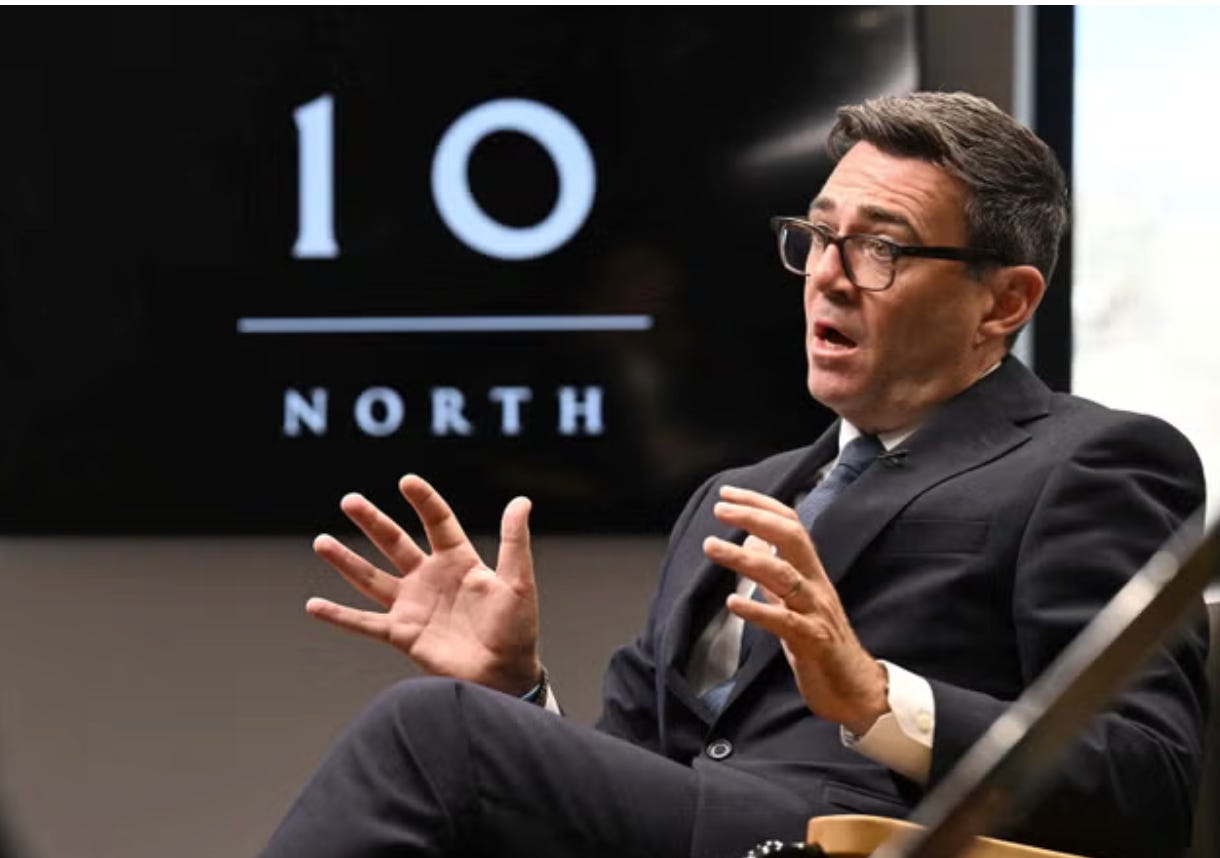
Watching the first in depth interview of Britain’s new PM Andy Burnham invites us to reflect on the format of political interviewing itself. What does it show us about the place ascribed to politicians, and especially those who will occupy - or aspire to - the highest echelons of political power?
Let’s start with a contrast with typical entertainment interviewing. An actor or musician is asked ‘ So what was it like to work with X?’, ‘Was there chemistry between you and Y?’, ‘What was your most embarrassing moment?’, ‘ What inspires you?’. Some of these are like the sort of questions that tweens might ask each other, exploring dynamics and interests, and learning about the other person’s life. They tend to be so repetitive that interviewees often find the whole experience mind-numbing, a mechanical exercise with pre-set answers, smiles and handshakes.
But the political interview is different. As Andy Burnham answered the questions posed to him carefully, with well phrased and balanced responses, the interviewer kept pushing. From asking how he got on with Trump in their initial phone call, the questions veered towards ‘But would you say No to Trump?’, from a recognition of the need for defence, to ‘Will you commit to the 3% of GDP arguably needed for the defence budget?’. All this knowing full well that a new PM is unlikely to commit themselves on a complex issue in a TV interview.
But what could be more reasonable? The PM, after all, looks after the interests of the country, and so a political interview has no choice but to push, to make commitments and loyalties clear and unambiguous. Questions have to be concrete, seeking out and testing policy decisions and allowing the public to understand what the priorities are for the incoming PM, and, basically, where they stand.
Actors and musicians might be asked about what they think about AI and copyright issues, but usually it doesn’t go too much further there. The premium is less on where they stand than on what they enjoy - their interests, passions, professional pathways etc. But what does the question of where someone stands ultimately aim at?
In the famous Cambridge election stand-off in 2017, where Theresa May failed to show up, the questions were about policies, certainly, but kept coming back to one essential dilemma - if the country were under attack, would you ‘press the button?’ The fact that this question seemed to be the bedrock of the whole debate is telling, and chimes with innumerable movies, novels and TV shows. When does an act of violence become justified?
It was exactly this question that capsized Michael Dukakis’ campaign against Bush in 1988. When CNN moderator Bernard Shaw asked him coolly whether he would consider the death penalty if his wife were raped and murdered, Dukakis’ dispassionate, rather abstract response, which discounted violent revenge, was a significant blow to his presidential chances.
This is the burning question. Violence needs to be legitimised, warranted by motives of defence - especially defending one’s family or a child - or of revenge, if the person or a loved one has been sufficiently wronged. And this is where the political interview shares so much not with tween convos but with primary school playgrounds - the questioner keeps insisting, Would you stand up to Trump or Putin? Would you push the button? In other words, how far would you go…like a playground dare.
Would you kiss X? Would you hit Y?
The playground motifs tend to converge on external acts of either physical affection or violence, but they both share the common framework of being done out of love and loyalty. We could imagine a political interview where the PM is asked, instead of what his defence budget plans are, ‘If intruders got into your home, and you had a firearm, would you use it to defend your family?’’ And if the PM avoided answering directly, the interviewer would just keep asking the question again and again, like a child who needs to know if they are loved.
What would you do for me? How far would you go?
Whether Burnham will be able to challenge Trump or whether he will commit to the defence budget are of course important questions, but beyond their obvious relevance we see the structure of a playground dare, and it is perhaps the very fact that in contrast to serious and measured politicians, some players here will boast of exactly what they WILL do, the dares they will fulfil, a style that may add to their popularity, even if, when push comes to shove, they renege on their promises.